I went to school to be an archaeologist and realized digging in dirt wasn't as fun as it was when I was a kid. Now I dig in archives instead.

Saturday, March 30, 2019

O'Reillys of Kilbeg, Co. Meath


The earliest I've so far managed to trace this particular family is to Charles Reilly of Robertstown, who lived at Robertstown Castle and operated a tannery on the grounds.  According to the local oral histories recorded in the National Folklore Collection, he also had four brothers, but their names were not mentioned.  Charles had a son, James, whose family group I was able to put together from the deed records in the Registry of Deeds Office.
  • James Reilly of Kilbeg
  1.  Charles Reilly of Kilbeg b. abt. 1792 d. 1870 Kilbeg, Co. Meath
  2.  Dr. Laurence O'Reilly of Ratoath b. abt. 1796 d. 1878 at 11 Goldsmith Street, Dublin
  3.  Rev. Bernard O'Reilly of Sarlat, France b. abt. 1803 
  4.  James O'Reilly of Clooney and of Mount Albion, Dundrum b. abt. 1806 d. 1872
  5.  Margaret Reilly
  6.  Bridget O'Reilly d. 1879 at 11 Goldsmith Street, Dublin
  7.  Frances O'Reilly m. Michael Grehan 1835, Castletown-Kilpatrick, Co. Meath
Charles Reilly of Kilbeg died in 1870, leaving behind three children whose names I have discovered so far: Fanny, Farrell, and John.  

Farrell O'Reilly, born abt. 1839, inherited the lands and house at Kilbeg upon his father's death in 1870.  He married Catherine Forde in 1879 in Lisdoonvarna, Co. Clare, and from this marriage came four children: Charles Farrell, John Valentine, James William, and Mary Kate.  Farrell O'Reilly was a good friend of a Dublin physician by the name of Dr. Henry Gogarty, whose son, the poet Oliver St. John Gogarty, would reminisce about Farrell in a poem published in November 1945 in The Bell, a Dublin literary magazine founded and edited by the writer Seán O'Faoláin, and again in May 1946 in the American literary journal Poetry.  Farrell died in 1908 at Kilbeg, and as far as I am aware descendants of his eldest son Charles Farrell O'Reilly continue to live at Kilbeg to this day.

Additional reading:
Gogarty, Oliver St. John. "Farrell O'Reilly." Poetry, May 1946, pp. 70-72.

Related posts:
Irish Deed Memorials, 1844: O'Reilly to O'Reilly
Robertstown Tannery

Saturday, February 9, 2019

Robertstown Tannery

Lately I've been working on transcribing some of the Irish local accounts collected in the National Folklore Collection, UCD as part of the Meitheal Dúchas transcription project and came across this one involving one of the people named in an earlier post here.  A while back I wrote about a deed among members of the O'Reilly family of Kilbeg, County Meath.  The deed mentioned that all the parties to it were the grandchildren of a Charles Reilly or O'Reilly of Robertstown.  This Charles is the subject of the particular local history piece I came across, that of the Robertstown Tannery.

Robertstown Castle,
Photo © Mike Searle (cc-by-sa/2.0)
Evidently Charles O'Reilly owned a tannery in Robertstown, and lived at Robertstown Castle, a fortified early 17th century house originally built by the Barnwall family.

The story about Charles O'Reilly and his tannery recounts the story about his wooden false-bottomed tanning pits (supposedly to fool the tax assessors), something that was also corroborated in other stories collected in the area.  What also stands out to me about this particular version is that this story mentions the existence of four unnamed brothers of this Charles O'Reilly, any one of which could have been ancestors of my line of O'Reillys.  Due to a member of my O'Reilly family inheriting from one of the Kilbeg O'Reillys mentioned in the 1844 deed, moving into his house after he died, and sharing a large overlap in family names between their family group and the Kilbeg family, a fairly close kin relationship of some kind seems almost certain.

For those of you who know where in Ireland your people were from, I highly recommend taking a look through the stories collected on the website.  Many still require transcriptions, so you may find something relevant that hasn't yet been made searchable on the site just by perusing the images, as I did with this story of "Charley beag the currier" and his tannery and castle.

Sunday, January 27, 2019

Beyond 2022 - Reconstructing an Archive

As I've written about before, Irish research can be difficult because gaps exist in the records due to the destruction (both intentional and accidental) of so many of them, including the catastrophic loss of most of the holdings of the General Record Office in 1922.  All is not lost, however!  A project launched last year, Beyond2022, aims to create a digital reconstruction of the holdings of the GRO using copies of records held by other sources.  The project, being carried out by Trinity College Dublin and several archival partners, is set to debut online on the 100th anniversary of the GRO fire, 30 June 2022.  As a genealogist, I'm particularly interested in how much of the missing wills can be reconstructed - I'm well aware most are probably gone forever, but I've personally managed to dig up a few abstracts myself in old British government publications as well as a few complete copies of wills that had been deposited in various archives in the UK and recorded in the deed memorial books of the Registry of Deeds in Dublin.  It'll really be something to see how much this project can uncover and restore with the partnership of so many major archives at their disposal.

Have a look at the project's trailer video below, and learn more and bookmark the project site at http://beyond2022.ie.


Friday, November 24, 2017

The Fagans' Rocky Genealogical Road to Dublin

The earliest known ancestor in my Fagan line is Peter Fagan, whose family were living in Hazleton, Pennsylvania by 1850.  He, his wife, Elizabeth, and their oldest three children (Julia, Garret, and Elizabeth) were all born in Ireland.  As the family tombstone states both he and his wife were born in Westmeath, I had thought that's where I'd find the family records, but recently uncovered evidence that there may be yet another Dublin story in my family tree.  The records I found also appear to knock down a little brick wall regarding discrepancies in the records of Elizabeth Fagan's maiden name.

Garrick, Samuel Walters
National Museum of American History, Smithsonian Institution
Gift of CIGNA Maritime Collection
The past few years of focusing on my O'Reilly ancestors has given me some valuable experience in dealing with Irish records and the problems they can have.  If I've learned anything, it's that sometimes there's more to a record than just what it says - names can be misspelled, dates can be estimated, and sometimes you have to look at the overall pattern of the document instead to determine if it might be "your" people.  It was a passenger record that fits this description that actually got me started.  This was the manifest of a ship named the "Garrick", which left from Liverpool and arrived in New York in September 1848.  The ship was in its time the fastest packet traveling the New York-Liverpool route, and a wonderful painting of the Garrick exists in the collection of the Smithsonian's National Museum of American History, depicting it at sail off the northern Welsh coast.  The manifest of the September 1848 arrival in the port of New York included a family group recorded as:

  • Pat Fegan, age 33
  • Eliza Fegan, age 19
  • Julius Fegan, age 5
  • Garrett Fegan, age 3
  • Eliza Fegan, infant

Now, I could look at this and reject it in hand on grounds that my family was spelled Fagan, the father's first name was Peter, and the eldest child was a girl: Julia, not Julius.  But when you take into consideration that these manifests were written by other people (many of the passengers were themselves illiterate), likely working in a hurry to record hundreds of names per voyage, you can forgive human errors in the records.  Much else about this manifest corresponds to the known ages and names of the Fagans (particularly the children) in the Hazleton records.  The overall pattern fits.  And taking into account that this ship left from Liverpool rather than Queenstown (Cobh), I gambled on a notion that there was a possibility the Fagan family had passed through Dublin first, perhaps picking up better paying work in the city to pay for their passage.  On a hunch, I decided to search the Dublin church records for them, and did it ever pay off.

The image shows a page from the register of St. Andrew's Catholic Church in Westland Row, Dublin, containing a marriage record - dated 30 January 1842 - between Peter Fegan and Eliza Grogan.  A further search through that parish between that marriage year and 1850 turns up only three baptisms for Fegan/Fagan with parents named Peter and Eliza/Elizabeth.  In birth order, those children were named Julia, Garret, and Eliza - exact matches to the known Fagan children born before the Fagans came to the United States, and their baptismal dates line up with the ages of the Fagan children in the Garrick's passenger manifest.  This marriage record also can rule out two of the possible surnames for Elizabeth Fagan that were listed in the death certificates of her children Robert Fagan - Rogan - and Elizabeth Fagan Dougherty - Brogan.  If the couple married in this record are the correct people - and I believe that they are - the correct surname for their mother is evidently the name that was recorded on the death certificate of another of the Pennsylvania-born Fagan children, Michael: Grogan.

Sources:
"New York Passenger Lists, 1820-1891." Database with images. FamilySearch. http://FamilySearch.org : 14 June 2016. Citing NARA microfilm publication M237. Washington, D.C.: National Archives and Records Administration, n.d.
Painting, Garrick - The National Museum of American History
Irish Catholic Parish Registers - unindexed images may be browsed at the National Library of Ireland and an index may be consulted for free at FindMyPast with registration of a free site account.
Ancestry.com. Pennsylvania, Death Certificates, 1906-1964 [database on-line]. Provo, UT, USA: Ancestry.com Operations, Inc., 2014.

Sunday, October 15, 2017

Irish Deed Memorials, 1844: O'Reilly to O'Reilly

Recently a fantastic new source was made available for Irish research - the deed memorials books from the Irish Registry of Deeds.  The majority of the books are available online now on the FamilySearch website, with a few remaining to be digitized.  The indexing system is far from perfect - you have to know either the grantor (either the landowner or a tenant who is subletting to an additional tenant) or the townland; there are separate index sets for both covering various date ranges.  The deed books are arranged in numeric order from their beginning up to 1832; starting in 1833 they are grouped by year with the book numbers beginning again at number 1 for every subsequent year.

Search the Registry of Deeds books at FamilySearch.

I've started exploring the books to try to find out the origin of my great-great-great grandfather, Laurence O'Reilly.   As I've previously written, I believed he was related to two brothers, Dr. Laurence O'Reilly of Ratoath and James O'Reilly.  So far I still haven't pinned down exactly who his parents were, but surviving records strongly suggest he is related to an O'Reilly family at Kilbeg, Co. Meath.  A deed I discovered in the Registry's records provided me with a full family group for these O'Reillys and confirmation that the doctor and his brothers were from the Kilbeg family.

Rather than transcribe the convoluted language of the deed in full, I'm just going to abstract and quote the most relevant portions to this family group.  I've cleaned up some of the early 19th century idiosyncrasies in punctuation, capitalization, and abbreviation and tried to cut out extraneous language to keep the relationships between the people involved as clear as possible.

Irish Deed Memorials 1844: Book 3, Number 101 - O'Reilly to O'Reilly
Registered 3 June 1844; memorial of an indented deed of assignment dated 1 June 1832; from Dr. Laurence O'Reilly, Frances O'Reilly and Bridget O'Reilly, all of Ratoath Co. Meath and Rev. Bernard O'Reilly of Sarlat, France; to James O'Reilly of Clooney, Co. Meath.  Mention of two earlier leases from the 1790s from George Williamson to "Charles Reilly of Robertstown".  Charles Reilly "grandfather to the parties in said deed" and James Reilly "father to the parties"... died intestate leaving children Laurence, Bernard, Frances and Bridget, the said James and also Charles Reilly, Catherine Reilly and Margaret Reilly the surviving children of  the said James Reilly... the last mentioned Charles Reilly of Kilbeg in the County of Meath, heir at law of the said Charles Reilly his grandfather and of said James Reilly his father had become entitled to lands... as such heir and further... said Laurence O'Reilly, Bernard O'Reilly, Frances O'Reilly and Bridget O'Reilly agreed to assign... said James O'Reilly their brother all their respective... interest in... said lease.

So, what is learned from this deed: the names of their father and grandfather, and their additional siblings.  We can also infer from the reference to their brother Charles as the "heir at law" that he is the eldest (and also that he died prior to 1872, the year James died, when Dr. Laurence O'Reilly is described in newspaper reports of probate proceedings as the "eldest surviving brother" of James O'Reilly).  It is also possible to use the land indexes to look up additional deeds relating to the properties named to try to find any additional ones that might involve the people in question.  One of the things that also struck me about the names included in this deed were just how many of them repeated in the O'Reilly family I know to be mine.  My great-great grandmother had brothers named Laurence, James, and Charles, as well as sisters named Catherine, Margaret and Frances.  I've also been looking into an additional family of O'Reillys located at Newgrove, which is located in the same barony as Kilbeg (Kells) and which documentation suggests were acquainted with the ones at Kilbeg and may have been a branch of distant cousins.  In both these families, there seems to be a clear pattern of chosen names which are then passed down.  I don't believe it's a coincidence that so many of my great-great-great grandfather's children bore the same names as the O'Reillys from Kilbeg.

[text has been amended to correct a previous misidentification of an O'Reilly sibling as a brother rather than a sister, which a subsequent discovery among the civil death registrations has cleared up]

Sunday, June 18, 2017

The Dublin of Joyce and O'Reilly


The baptism of James Augustine Joyce, St. Joseph's Church, Terenure (NLI Registers)
This past Friday was a literary holiday of sorts, particularly in Dublin, marking Bloomsday, the day that Leopold Bloom, the protagonist of James Joyce's Ulysses, made his sojourn through Dublin on 16 June 1904.  A group of Dublin's literati began to mark the occasion by recreating Bloom's adventures in a pilgrimage of their own, and so the Bloomsday tradition was born.  Now, a discussion of Irish literature might seem an odd topic for a genealogy blog, but Joyce's Dublin is actually also "my" Dublin.  The same city as he knew it was the city as my ancestors knew it, in the places they lived and went to church and in the streets they traversed, and so I'm sharing a few of those places and what their significance was in my research on the O'Reilly family in Dublin.

St. Joseph's, Terenure (Dublin City Libraries)
The first stop on this historical journey through Joyce's Dublin is the church where he was baptized, St. Joseph's in Terenure.  I've written about St. Joseph's before, and how the registers of that church provided information on the location of relatives who had gone to America.  Part of Joyce's baptismal entry in the registers, from February 1882, can be seen in the image at the top, the full page may be seen here.  My cousin Isaac O'Reilly was also baptized at St. Joseph's just a few years before Joyce, and Isaac's wife Julia Mannering was also from that parish.  As I've previously written on these O'Reillys, Isaac and Julia were married at St. Joseph's in 1897, and since all of Isaac's immediate family were living in America, his uncle Laurence O'Reilly was his witness.  Laurence's address was given as 5 North Richmond Street.

A first edition of Ulysses
Harry Ransom Center for the Humanities, Austin, Texas
Photo: A. R. Dotson
At the time my great-great granduncle Laurence O'Reilly listed his address in his nephew's marriage record, number 17 North Richmond Street was occupied by a large family represented in the Thom's Dublin directory under the name of "Joyce, John, esq."  This head of house was John Stanislaus Joyce, the father of James, who in February of 1897 would have just turned 15.  North Richmond Street was a short street consisting of only 20 households, and uncle Laurence had children of his own around the same age as the Joyces.  It's quite possible the two families were acquainted.  What we do know is that North Richmond Street left enough of an impression on the young James Joyce to appear in two of his works: a short story in Dubliners entitled "Araby" and in Ulysses.

The Bleeding Horse, Camden Street
Photo: A. R. Dotson
Laurence, who had been promoted to superintendent in the Dublin Metropolitan Police by the time he resided on North Richmond Street, had moved his family to that address from number 29 Lombard Street West, a Victorian terraced house in Portobello, where they had lived just around the corner from his widowed mother Bridget.  Lombard Street itself is part of the Dublin of Ulysses, being a former address of Joyce's protagonist Leopold Bloom.  A short walk from what was the O'Reilly home, just around the corner past their church, St. Kevin's, is Camden Street and yet another landmark of the Dublin of Ulysses.  "I saw him a few times in the Bleeding Horse in Camden street with Boylan the billsticker" says a character named Corley in reference to Bloom (Ulysses, Episode 16: "Eumaeus").  Even today, you can stop in at the Bleeding Horse for a pint.  It's still there, just as it was when the fictional Leopold Bloom was seen there, and just as it was when my very real ancestors lived in the neighborhood.  Who knows, they may have been seen in there a few times themselves!  

Saturday, May 20, 2017

Catherine (Ryan) Treston, 1916 Rebel

Cumann na mBan members, 1916 (Richmond Barracks)
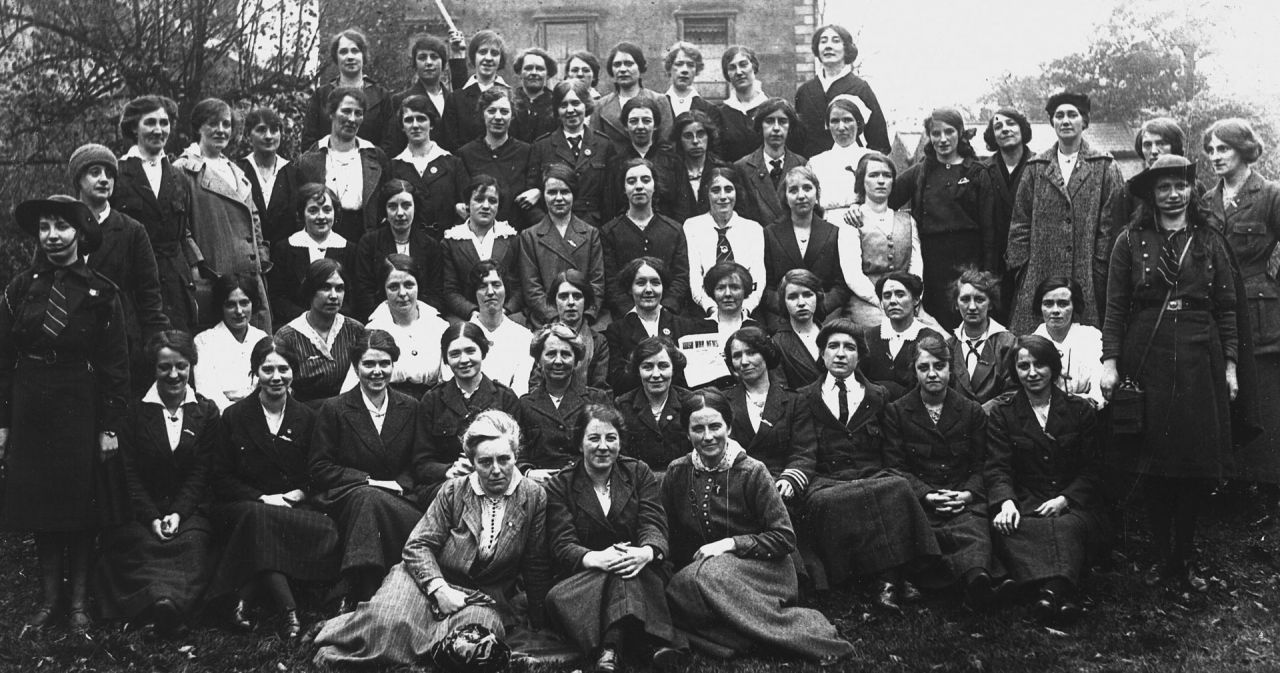
As Treston is one of my Irish ancestral names, and not a particularly common one at that, it caught my eye when I saw a Treston on a list of women participants in the 1916 Easter Rising.  I investigated, and though this particular Treston turned out to be a distant relative by marriage and not by blood, what I found is still pretty interesting.

According to the records of Richmond Barracks, Catherine "Cathleen" Treston, née Ryan, was a member of Cumann na mBan's Central Branch, and had been a nurse in the GPO garrison during the Rising.  She was detained in both Richmond Barracks and Kilmainham Gaol in the aftermath, and presumed to have been released on the 8th of May, though the Kilmainham records from this period have been lost.  She is present in the group photo here, taken in the summer of 1916 in the garden of Ely O'Carroll.  The woman in all white in the next to last row, wearing what appears to be a white nurse's cap, has been identified as Mrs. Catherine (Cathleen) Treston.  Cathleen would have been about 26 years old in 1916, going by her age in the 1911 census.  Her name is included in the 1936 Roll of Honour of participants in the Rising.

The 1911 census tells us a little about her home life in the years leading up to the Rising.  She was married to a dentist, William Treston, and was already the mother of two infant daughters.  She and her family lived with her widowed mother, two sisters who taught at the National School, and an aunt in a house in Ballybough Road.  Her husband's family, from what I can tell, descend from the Blackrock branch of the Treston family, who originated at some point in Mayo and are distantly related to mine.  So while Cathleen herself was not a cousin of mine, her husband and daughters certainly were, albeit distantly.

Sources:
Richmond Barracks, A list of women who were detained at Richmond Barracks
National Museum of Ireland, Women of the Roll of Honour
Sinéad McCoole, No Ordinary Women: Irish Female Activists in the Revolutionary Years, 1900-1923

Friday, April 14, 2017

The Will of Catherine Bonynge of Ratoath

The Four Courts, 30 June 1922
Photo courtesy NLI Commons
30 June 1922:  Three days into the Battle of Dublin, the first conflict in what will become the Irish Civil War, fire breaks out at the Four Courts, home to the Public Records Office, leaving the building a burned-out shell and destroying most of its 800 years' worth of holdings.  To this day the precise point of origin of the conflagration remains unclear; the building had been under heavy shelling by the Free State army for the previous two days while anti-Treaty Irregulars were holed up inside. The one indisputable fact of the destruction of the Four Courts is that much of Ireland's official recorded history went with it, including nearly all of the wills held by the Principal Registry.  This background is necessary to explain why the survival of any of Catherine Bonynge's will, let alone as large a portion of it as we have, is somewhat remarkable.

Catherine Bonynge (or Bonnynge) was one of the two sisters memorialized at Glasnevin Cemetery by Dr. Laurence O'Reilly of Ratoath, Meath, buried in the same plot as Dr. O'Reilly and his brother and (possibly?) sister, James and Bridget O'Reilly.  She and her sister, Bridget Bonynge, were spinsters who lived at Ratoath, and evidently owned quite a bit of Dublin real estate.  Both died within days of one another at Ratoath in 1841, and were buried together in Glasnevin Cemetery, Dublin, beneath a monument bearing their names and Dr. O'Reilly's.  The Prerogative Court, which proved Irish wills until the Principal Registry was established in 1858, did leave a surviving index of the wills recorded there, and shows that both Bridget and Catherine left wills.  Those originals would have been among the records destroyed by the Four Courts Fire in 1922, but a hefty portion of Catherine Bonynge's will survives, published with other Irish charitable bequests, among the Parliamentary session papers of 22 January-28 August 1846.  Unfortunately, whatever relationship existed between the Bonynge and O'Reilly families remains unanswered by this portion, though it is not outside the realm of possibility that Dr. O'Reilly may even be the unnamed executor.  Whatever questions it leaves unanswered aside, one thing it does provide us with is a small historical window into Dublin in the first half of the 19th century.  I have reproduced the surviving text in full and annotated it below:

Saturday, March 25, 2017

The Mystery of the Misses Bonnynge

Last October, while I was in Dublin, I took a trip to Glasnevin Cemetery on the northside of the city to visit some family graves.  My great-great-great grandparents, Laurence and Bridget (Treston) O'Reilly, are buried there as are four of their children and two of their grandchildren.  While those plots are unmarked, as many in the cemetery are, I did find a marker on another plot that raised some questions.

In the area of the old chapel (since demolished), the section of graves are still called the Chapel Circle.  My great-great-great grandfather's predecessor at Mount Albion House in Dundrum, James O'Reilly, and his brother, Dr. Laurence O'Reilly, as well as a presumed sister of theirs, Bridget, are all buried in the Chapel Circle section.  Now, I still haven't determined the precise relationship between these O'Reillys to mine, but my working theory is that James and Dr. Laurence are most likely uncles of my Laurence.  The surprise here is that the grave was marked after all (a previous attempt my parents made on an earlier trip had not found the correct location, it turned out), and not only that, the O'Reillys weren't alone.  The marker on the grave reads:

Photo © the author, 2016
Erected in memory of the
MISSES BONNYNGE.
By DOCTOR O'REILLY - Ratoath.
In life respected
In death regretted.
May they rest in peace amen.
J. Farrell Ft 1841
I knew this was the right O'Reilly, because he was a doctor and did live in Ratoath, but the Bonnynge name was wholly unfamiliar to me.  So who were they?  How were they connected to the O'Reillys?  Once I'd arrived back in the States, I emailed the cemetery's office and received confirmation that the O'Reilly plot and the Bonnynge plot were, in fact, one and the same.  I've also since uncovered some more information that superficially answers one of my initial questions - who they were.  That's an entire post in itself, though, so it will have to wait.

Additional historical note: the bottom left of the inscription is the mason's signature.  The "Ft" is probably an abbreviation of the Latin "fecit" - literally "J. Farrell made it".  To this day, the company of Farrell & Son continues to make headstones and monuments just down the road from the cemetery.  The Irish Times published an article on the history of the company back in 2008.

Post-Travel: Dublin

St. Kevin's, Harrington Street, Dublin
As you might have noticed, I've been on hiatus for quite a while.  Longer than I realized, even!  I spent quite a bit of last year prepping for a trip to Ireland at the end of the year, in which I managed to achieve some of my genealogical goals there, missed out on others, and created a few brand new ones.  Since then I've had a bit of a travel hangover, and subsequently got more than a little distracted with current events in America, but the less said of that, the better.

Accomplished: visiting one of the neighborhoods my Dublin ancestors lived in, walking down their streets and even stepping inside their parish church, St. Kevin's (pictured).  This one was a big one for me!  I also got to visit Glasnevin Cemetery, where many of them are buried, and got to see their gravesites as well as the graves of many people who are important to Irish history.

Missed out: visiting the National Library, National Archives, and Registry of Deeds.  Unfortunately, none of the days I was in Dublin corresponded with times any of these repositories were open.  The only weekday we were there was Halloween, which is a big public holiday in Ireland and so they were all closed that day too.  Next trip over I'm definitely staying in Dublin during the week!

Stained glass window, St. Kevin's
Brand new research goals:  I'll leave those to their own posts!  That's honestly been part of the problem picking up again and blogging, I can't decide where to even start.  Let's just say I've uncovered some interesting new research angles to explore with my Irish relatives, including a recent discovery of additional ties to Dublin in another branch of the family.  Of course, my main goal is to go back!  Dublin is an incredible city, and despite it not being "home", thanks to spending much of the last few years researching it, it felt comfortable and familiar.  There's so much to see and do there as well.  It truly is a global treasure and I couldn't help but understand why so many people in my family made it their home.

Photographs of St. Kevin's © the author, 2016.

Sunday, March 13, 2016

A Cross and a Creole

This past March 5th was "It's My Park Day" here in Austin, and so I signed up to spend the morning documenting headstones at Oakwood Cemetery.  Oakwood is the oldest cemetery in town, and I'd visited it before to locate headstones of relatives buried there.  In fact, we started out documenting directly across from one of those plots - that of my 3x great-granduncle Dr. William Neal Watt, a North Carolina native who'd followed two siblings to Burton, Texas before moving on to make his home in Austin.

Caroline Deblanc Fortier
July 1 1843 - June 21 1895
While documenting one of the plots, a stone in the one adjacent to it caught my eye.  It was a granite monument about 5 feet high, in the shape of what's known as a "fleur-de-lis" cross.  I like to call them "French crosses", because I always associate them with French Catholic iconography.  The surname on it, Fortier, seemed to go along with that association.  The group working that plot had some trouble with the inscription due to the morning sunlight hitting the wrong side of the stone, so a few of us had walked over to see if we could help out.  Once the necessary info was obtained, it was just about time to finish up and leave for the day.

Only that wasn't quite it.  Not for me.  Something about that stone just wouldn't leave me alone.  I wanted to know more about the woman buried beneath it: who she was, where she came from.  Rainy, overcast weather also kept me from going back to try to obtain a clearer shot of the stone during the week (as it turned out, afternoon light helped me get a much more legible inscription, as you can see).  Fortunately the cemetery's burial registers are easily accessible online via the Austin History Center, so I was at least able to do some preliminary legwork via the internet.  Since I knew the year of death I was able to locate the correct entry despite a mistranscription of the surname as "Fortin".  This was where I was in for a revelation:  Mrs. Caroline Fortier, who died in Austin in 1895, was said in the burial register to be from Liberty County, Texas.  Aha, I thought.  And then, Hmm, maybe...

From a further search through the census records of Liberty County from 1850-1880, I was able to deduce that Mrs. Fortier was née Caroline Deblanc, a daughter of one of the original interrelated Creole families who had come from Natchitoches Parish to Liberty County in the 1840s!  Since my 3x great-grandmother Esilla Rachal and her parents were also some of these Liberty Creoles it's almost certain they even knew each other and may have even been relatives.  Caroline's mother was a Gillard, another of the main Liberty migration families, and I found baptisms matching a couple of Caroline's siblings in the books of Natchitoches records I keep at home, confirming their identities as Natchitoches Creoles.  I don't have a match yet for Caroline in those books, but I'll keep looking and check into a few additional published sources of Louisiana records to see if anything turns up.

Since the Liberty Creoles have been an ongoing genealogical and historical research project of mine for some time, the discovery of one buried so close to my home is nothing short of serendipitous.  And to think, it was all because of that particular style of cross grabbing my attention.  The stone spoke and I listened, and found a Creole kinswoman as a result.

Tuesday, March 1, 2016

A Tale of Two Hannahs

This particular genealogical rabbit hole I've gone down highlights the importance of exploring every avenue in the search for our ancestors.  You just never know what possibilities a collateral line may open up.

One of my ancestors I don't know much beyond is my great-great grandfather Patrick DeWan, who came from Ireland to the U.S.  Perhaps the most useful information I was able to find came from his Pennsylvania death certificate, filed 1 January 1923, giving his parents' names as Michael DeWan and Hannah Britton.  He was certainly here sometime before the end of the American Civil War, as he appears, aged 26, in a draft registry from July 1863 in Herrick, Pennsylvania.  There was just one problem: I couldn't find him on the census until 1880.  In fact, he didn't seem to be in Pennsylvania at all for the census years of 1860 and 1870.

A new possibility opened up when I came across the obituary of Mrs. Nora McGovern, an in-law of the DeWans.  Nora was married to James McGovern, whose sister Anna was Patrick's wife and my great-great grandmother.  Their marriage record in 1897 showed James as the son of Patrick and Bridget McGovern, which I already knew, and Nora (here as Hanora) was the daughter of Charles and Hannah McKanna.  I hadn't found a death record for Nora, and the obituary told me why.  I was looking in the wrong place - she died in Harrisburg, not Herrick.  Once I knew the place and date, pulling up her death certificate was fairly easy.  Nora's father, according to her death certificate, was named Charles McKenna.  Much to my surprise, I saw a familiar name - Nora's mother was also named Hannah Britton!  It seemed almost too coincidental, so I set about trying to find Nora's family in the records to see if I might be able to make a connection between her Hannah and Patrick's.  Could these two mothers with the same name have been the same person?  Could Nora have been Patrick's half-sister, in addition to a sister-in-law?  (Nora's sister, Ann, had their mother's name as Bridget Britton on her death certificate, but this is the only incidence I've found of her name recorded as something other than a variant of Hannah.)

In the 1870 census for Herrick, I found the family listed under McCanna: head of house Charles, then Hannah, and daughters Anna, Hannah (Nora), and Mary.  Interestingly, below the name of the youngest daughter was written another name: Patrick, aged 25!  Was it possible this was Patrick DeWan, and the census taker simply hadn't bothered to ask if he had a different last name than the rest of the house?  I decided to try to find them in 1860.  This time I found them all under McCamna: Charles, Hanora, Patrick (19), Michael (15), Ann (4), Hanora (3), and Mary (1).  Patrick's death certificate gave his father's name as Michael DeWan, and one of his sons had Michael as a middle name.  Could it be possible that once again the DeWans were listed as McKannas on the census?  It isn't unheard of for stepchildren to be recorded in the census under a stepfather's surname.  There's also quite a large gap in the ages of the children listed, which lends some credence to the possibility that not all these children were full siblings.  Patrick and Michael also are listed as being born in Ireland, and the girls were all born in Pennsylvania.  At this point I double checked for McKannas among the 1863 draft list that Patrick DeWan had appeared in.  I did find a Patrick McKanna - but he was 36 years old in 1863, making him less likely to be the same Patrick who was enumerated with Charles and Hannah's household.  A browse through the 1850 census of Herrick turns up a full household of McKanas - including a 30 year old Charles, who appears to be single, and a 22 year old Patrick who more closely matches the draft register's Patrick McKanna - and no DeWans or Brittons.

Out of curiosity, I went forward, looking for Charles and Hannah in 1880, and found something else unexpected: their household was located directly next to that of Patrick and Anna "Dwan", my great-great grandparents, who had been married within the year.  The lack of the 1890 census means a gap in the records that can't be accounted for, but the death register and cemetery listings for the area do tell us that Charles and Hannah died in the 1890s.

I think my next obvious step is to try to find a marriage record somewhere for Charles and Hannah.  If the 1850 census is for the correct Charles, it seems likely the marriage took place in or near Herrick between 1850 and 1855.  The Catholic records for the area may turn up something.  A search in the probate records may also be useful to see just who inherited Charles and Hannah's farm.

Saturday, October 10, 2015

The Scotts of Scot's Hall Portraits

The idea for this post came from the discovery that several Scott family portraits are now in the collection of the North Carolina Museum of Art.  These portraits were all among those reproduced as engravings in 1876 for the privately published "Memorials of the family of Scott, of Scot's Hall", so I thought I'd go through the portrait list published in the book and see how many I could track down to the present day.  This does not include any of the family memorials, which presumably have not left the church walls and floors they were placed on!  Where possible, I have provided a link to view the actual portrait, as the quality of the engraved reproductions varies substantially.  The provenance of the portraits at least until 1876 can be relatively assured: it was then that the engravings were reproduced with the permission of the widowed Mrs. Thomas Fairfax Best.  Mrs. Best's deceased husband was the son of Caroline Scott and Mr. George Best (per Burke's Landed Gentry) and a grandson of Edward and Margaret (Sutherland) Scott of Scot's Hall.  Portrait locations will be added as discovered.

Portrait of Reginald Scott, 1542 - NC Museum of Art
Portrait of Sir Thomas Scott, 1585 - unknown, though the engraving matches copies in the NPG from 1803
Portrait of Sir John Scott of Nettlested - NC Museum of Art
Portrait of Lady Elizabeth Scott - NC Museum of Art, identified as Emmeline Scott
Portrait of Lady Catherine Scott - NC Museum of Art
Portrait of the celebrated Mary Honywood - NC Museum of Art
Portrait of Edward Scott, Esq. D.C.L. - unknown
Portrait of George Goring, Earl of Norwich, Commander of Royalist Forces, Kent - unknown
Portrait of the Countess of Norwich -unknown
Portrait of Colonel George Goring (may be misidentified; see NPG collection) - NC Museum of Art
Portrait of Sir Thomas Scott - unknown
Portrait of Lady (Caroline) Scott - unknown
Portrait of George Scott, Esq. of Scot's Hall - unknown
Portrait of Anne Pemberton, 1st wife of George Scott, Esq. - unknown
Portrait of Cecilia Dering, 2nd wife of George Scott, Esq. - unknown
Portrait of Commodore Scott - unknown
Portrait of Margaret Sutherland, wife of Edward Scott, of Scot's Hall - unknown
Portrait of the Honble. Lady Mary Compton, wife of Captain Arthur Scott, R.N. - NC Museum of Art
Portrait of Caroline Scott, wife of Thomas Best, of Chilston Park, Kent - unknown
Portrait of Thomas Best, Esq., M.P., of Chilston Park - last sold in 1997, buyer unknown
Portrait (Medallion), Mrs. George Best, Chilston Park - auctioned; buyer unknown

So now let's talk about the attributions provided by the book.

Thursday, August 6, 2015

Oceanic: Queenstown to Ellis Island, May 1913

This one's a very special post for me, as it combines one of my favorite things, historic ships, with a truly amazing find in an immigration document that confirms quite clearly my previous research.

To the right is a photo of the White Star Line's Oceanic (II), which was built at Belfast's Harland & Wolff shipyard in 1899.  Until 1901 this ocean liner was the largest ship in the world, and until requisitioned by the Royal Navy in 1914 and run aground that same year off Shetland, she carried thousands of immigrants to new lives in America from the ports of Cherbourg, Southampton, Liverpool, and Queenstown (Cobh).

One such passenger, who boarded Oceanic at Queenstown on 8 May 1913 and debarked at Ellis Island one week later on the 15th, was Laurence O'Reilly of Ballyhaunis, Mayo.  Before I go into what the ship's manifest says about him, I'd like to fill in a little background on him first.  He was born on 2 December 1883 and baptized Laurence Christopher O'Reilly on 5 December 1883 at St. Agatha's, Dublin (Laurentius Christopherus O'Riely in the transcribed record).  His father, Laurence John O'Reilly, a Superintendent in the Dublin Metropolitan Police, was head of the household in the 1901 Irish census when the entire family lived at 5 North Richmond Street.  Laurence Christopher, the oldest son, was 17.  By 1911, Supt. O'Reilly had retired and moved his family back to his home county of Mayo.   27-year-old Laurence Christopher is still in their household at Carrowneden, just outside Ballyhaunis, in the census of that year.

The first page of the manifest of Oceanic's May 1913 voyage gives his age as 28 (he had actually turned 29 the previous December), says he is a shop assistant, of British nationality and Irish origin, last residence is Ireland and his father is Laurence O'Reilly of Ballyhaunis.  It's on the second page of the manifest that things get really interesting: the younger Laurence's destination is Hazleton, Pennsylvania (spelled "Hazelton" on the manifest), his steerage ticket was paid by his father back in Ireland, and the relative he was on his way to was his "Aunt Mrs. Delia Fagan" of Lattimer Mines.  And there it was: my great-great grandmother's name, in black-and-white, confirmed as the sister of this Laurence's father!  Even though I was already sure of her place within the O'Reilly family back in Ireland based on the few records I had, the surviving records contained some inconsistencies in names and dates.  This passenger list explicitly laid out the family relationship, and since it refers to her married name, Fagan, there's absolutely no doubt of her identity.  It was exactly the kind of concrete evidence I'd hoped to find, and in a most unexpected place!  This definitely ranks very high on the list in terms of the most exciting family document finds for me.

The lesson here is that it's always worthwhile to check immigration records for collateral relatives.  You may be surprised what information the passenger lists for these other relatives can tell you about people in your own direct line, and they may provide precisely the evidence you need to link your own family back to their family of origin in their native country.

For more on Adelia O'Reilly Fagan:
What's in a name? Adelia, Delia, Bedilia and Bridget; or check out all posts tagged "O'Reilly".

Image: 'Oceanic' moored at Harland & Wolff shipyard, Belfast courtesy PRONI (via flickr)
Sources:
Ancestry.com. New York, Passenger Lists, 1820-1957 [database on-line]. Provo, UT, USA: Ancestry.com Operations, Inc., 2010.
The National Archives of Ireland. Census of Ireland 1901/1911 and Census fragments and substitutes, 1821-51 [database online.]
Department of Arts, Heritage and the Gaeltacht.  Church Records [database online].

Thursday, July 30, 2015

Filling In Gaps with the NLI Parish Registers


The biggest, most exciting event for genealogists researching Irish roots this year has got to be the release of hundreds of digitized images from the National Library of Ireland's collection of church parish registers.  Thanks to these records, I've been able to fill in some gaps and address some of my speculation regarding my own research.

1) I had theorized that a baptism record for Julia Bridget O'Reilly in the parish of Bekan, Mayo, which I believed to be my great-great grandmother Adelia's baptism, had been misread and that what someone had read as Julia could be Delia.  As it turns out, the transcription was incorrect, just not in the way I had thought it would be.  She was actually baptized Julia Bedelia O'Reilly.  That name makes me even more sure that the record is my great-great grandmother's, for reasons which I've already explored in a previous post.

2) I had also suspected that an Isaac O'Reilly who lived in Rathfarnham was the same person as one of Adelia's nephews, a son of her brother James.  Finding the marriage record of Isaac and his wife Julia (Mannering) in the parish records of St. Joseph's in Terenure confirmed that Isaac was indeed the son of James O'Reilly and Margaret Rothery.  Furthermore his witness at the marriage was none other than Laurence O'Reilly of 5 North Richmond Street, his uncle and James and Adelia's brother.  The record also provided the important information that Isaac's parents were living in the U.S. in Delaware City, Delaware.  Thanks to that clue, I looked into Delaware records and was able to track down both the baptism record of Isaac's sister Sarah and the marriage record of his brother Laurence.

Search the NLI Parish Register collection

Postcard image of St. Joseph's Terenure courtesy South Dublin Libraries 

Thursday, July 16, 2015

Dr. Watt of Oktibbeha County, Mississippi

This is a brief follow-up to a previous post I wrote on members of the Watt family buried in Steele Creek ARP Cemetery in Charlotte, North Carolina.  Among the graves of the immediate family of the Rev. James Bell Watt was a gravestone for a Dr. William J. Watt who had died in 1857.  I didn't know the name, but wondered whether he could be the younger brother of Rev. Watt referred to in a biographical entry on one of Rev. Watt's sons.  I've since found some additional information on him and his possible relationship to the Steele Creek Watts.

In 1850, a "Doc" William J. Watt, whose age matches that of the gravestone at Steele Creek, is living in Oktibbeha County, Mississippi.  The name that follows his, Virginia, is evidently his wife, and the census indicates they have married within the year.  His birthplace is given as South Carolina, and if we'll recall, Rev. Watt was also originally from Fairfield County, South Carolina.  The 1860 census shows Virginia Watt as the head of household in Starkville, Oktibbeha County, as would indeed be the case if her husband had died in 1857!  Notice also that their oldest son is named James Bell Watt.  Their younger son John apparently died later that year.  His gravestone stating he is the son of "W. J. and V. C. Watt" is located in the ARP Cemetery in Starkville.  That same cemetery is full of Watts, Bells, and Montgomerys who came from the Fairfield District and were all kin to the Steele Creek Watts, including three of the brothers of Rev. Watt's first wife, Nancy Bell.  By 1870 Virginia Watt had married again, when her two surviving Watt children can be found in the household of her second husband, James P. Curry.  In 1880 she is a widow again, and lives with her Curry children.  Her son James B. Watt is enumerated just above her.  Her daughter Margaret Watt married Dr. Samuel A. Montgomery, a descendant of the Fairfield Montgomerys; further information on him can be found on page 450 of this book.  Virginia herself lived until 1899, and is buried in Odd Fellows Cemetery in Starkville, Mississippi.

Given the heavy presence of Fairfield County natives in the Starkville ARP congregation, particularly of those closely connected to the family of Rev. James Bell Watt, my opinion is that it is likely that "Doc" Watt who appears on the census in 1850 was also from Fairfield County.  I think it is also likely that he is the same person buried at Steele Creek and that he was the brother that Rev. Watt's son's biography referred to.  Of course, my investigation is still not complete and there are still offline sources I'll need to hunt down and check up on, but so far nothing found rules this particular relationship out.  Quite the contrary, what circumstantial facts we have would seem to support it.

Sunday, July 12, 2015

A Tragedy at Campti

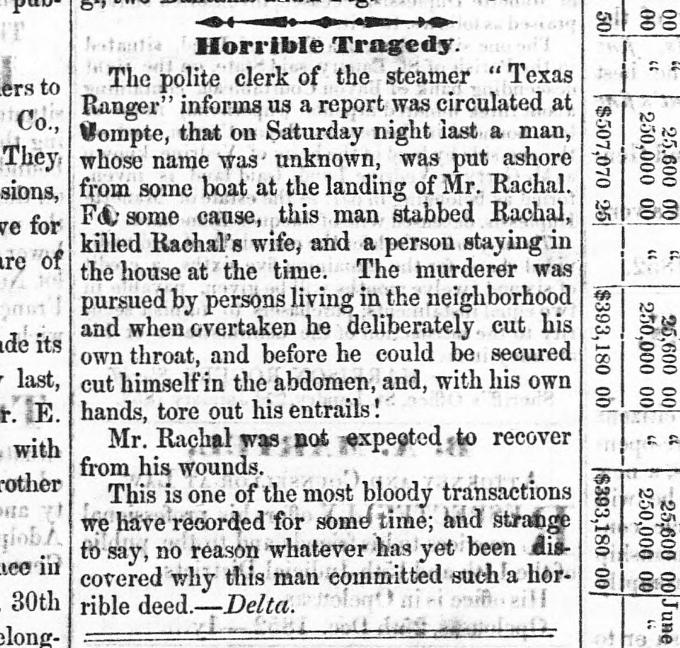
The Opelousas Courier, 12 Feb 1853
Again I'm bringing clippings from the Opelousas Courier relating to people from the Natchitoches area.  These two, which I came across while working on the post relating to deaths at Cloutierville published in the same journal, recount the story of a bizarre and inexplicable crime befalling a member of the Rachal family.  It's precisely the type of story that often gets lost or only hazily passed down among the simple aggregation of names and dates that often constitutes a genealogy.  The brief account in English is included here in the image to the right; below is my translation of the further details published the following week in the French edition of the same paper:

On the evening of 21 January [1853], a man named Samuel Summers disembarked from the steamboat John Strader at Rigolet de Bon Dieu and spent the night at the home of Mr. Cockfield.  The following day and night he proposed to spend at the home of Mr. Onézime Rachal.  In the afternoon he chatted with a person named Standish, and engaged him to go outside with him.  Standish agreed to his wishes and accompanied him outside; but they were just a few paces from the house when Summers drew from his pocket a knife and tried to cut his throat.  Standish, in resisting, received such a deep wound to his abdomen that his entrails were exposed.  A few moments after he ceased to live.

Drawn by the noise of the fight, Mr. and Mme. Rachal appeared outside; Summers, when he saw them, rushed toward them, knife raised, and inflicted several blows to the husband and wife.  The latter was mortally wounded.  The house-guests and servants, at the sight of the appalling tragedy, were seized with panic and fled.

As the news of what had happened spread throughout the neighborhood, many inhabitants armed themselves in haste and went in pursuit of Summers.  They found him after half an hour in a field belonging to Mme. Metoyer, two miles from the Rachal residence, but he had attempted suicide, for he had a large wound to the throat and three others to the abdomen.  He was taken to the prison and succumbed there during the night.  It is thought that Summers was a madman escaped from some hospital.  It is indeed impossible to conceive of such a crime on the part of a man capable of reason.

I searched the Natchitoches books I have copies of to try to determine who Onezime Rachal's parents were, without any luck.  I don't own a copy of every published Natchitoches record book that exists, though, so it is possible I may yet find him the next time I consult one of those in a library.  The 1850 census contains an entry for an "Onizieme Rachal" with a wife named Amelia.  The 1832 baptism of Marie Aimée Liegue Brevel, daughter of Jean Bte. Brevel and Marie Euphrosine Lestage, was sponsored by Onézime Rachal and Marie Aimée Lestage, "Mrs. Onézime".  Baptisms in the 1840s that Onézime sponsored are sometimes co-sponsored by either Emelie Lestage or Emelie Rachal.  Are Emelie and Aimée the same person, or is Emelie a second wife?  Is Amelia a census enumerator's anglicization of her name?  And is Emelie Lestage the Mme. Onézime Rachal who was killed at Campti?

Sources:
The Opelousas Courier, 12 February 1853 <http://chroniclingamerica.loc.gov/lccn/sn83026389/1853-02-12/ed-2/seq-2/>
Le Courrier des Opelousas, 19 February 1853 <http://chroniclingamerica.loc.gov/lccn/sn83026389/1853-02-19/ed-1/seq-1/>
Ancestry.com. 1850 United States Federal Census [database on-line]. Provo, UT, USA: Ancestry.com Operations, Inc., 2009.
Riffel, Judy. Natchitoches Baptisms, 1817-1840: Abstracts from Register 6 of St. Francis Catholic Church, Natchitoches, Louisiana. Baton Rouge: Comite Des Archives De La Louisiane, 2007.
Riffel, Judy. Natchitoches Baptisms, 1841-1849: Abstracts from Register 9 of St. Francis Catholic Church, Natchitoches, Louisiana. Baton Rouge: Comité Des Archives De La Louisiane, 2010.

Sunday, July 5, 2015

The Burton Free School


These photos, from the application packet for the 2013 historic site designation for the public schools in Burton, Texas, show Burton students ca. 1910.  Of those identified, I have spotted several names familiar to me from my research of this area.  The child identified as Bill Bryan in the photo on the left and the bottom photo on the right is my great-grandfather, and the others with the same surname are his siblings.  Additional relatives in these photos are the Watts, McCains, and Burkes, who were their cousins.

The associated historical marker reads:

Burton Public Schools opened in 1874, and by 1926 nine grades were offered. In 1938, construction on Burton’s first high school began. Funded through the federal Works Progress Administration (WPA), the building was completed in 1940. Designed by architect Travis Broesche and built by local contractor Will Weeren, the school exhibits international and rustic architectural style. Features include abutting two-story rectangular blocks, a curved wall near the entrance, and a native field stone veneer.

Source:
Texas Historical Commission. [Historic Marker Application: Burton Public School]. The Portal to Texas History. http://texashistory.unt.edu/ark:/67531/metapth491853/. Accessed July 5, 2015.

Saturday, July 4, 2015

Revolutionary War Patriot Ancestors

Happy 4th of July!  Today I'm sharing a list I've compiled of my DAR-eligible patriot ancestors.  The numbers and abbreviations following the names are the numbers as indicated by the DAR Patriot Index and the state served.  Lineage through my paternal or maternal line is indicated by a (P) or (M).

1. Baker, Thomas - #A005106 VA (P)
2. Bell, William - #A008824 SC (M)
3. Buchanan, Alexander - #A016383 NJ (P)
4. Bullock, Micajah - #A016885 NC (P)
5. Cheatham, William - #A202873 VA (P)
6. Clay, Charles, Sr. - #A022833 VA (P)
7. Clay, Jesse - #A022850 VA (M)
8. Dalby, John - #A029356 VA (P)
9. Ford, Nathaniel - #A040933 SC (M)
10. Guyton, Joseph -  #A048677 SC (P)
11. Hickerson, John - #A111186 VA (P)
12. Hurt, Moses - #A088208 VA (P)
13. Kelsey, Samuel, Jr. - #A064394 SC (P)
14. Kelsey, Samuel, Sr. - #A064398 SC (P)
15. Lemoine, Charles – not in patriot index but was in Natchitoches Militia LA (M)
16. Montgomery, Charles - #A078960 SC (M)
17. Morgan, Nathaniel - #A034848 VA (P)
18. Rachal, Julien - #A200189 LA (M)
19. Stone, Micajah - #A109702 VA (P)
20. Thaxton, William - #A113929 VA (P)
21. Turner, James - #A117084 VA (P)
22. Waters, Joseph (Watters) - #A122240 NJ (M)
23. Wright, Robert - #A130983 VA (M)
24. Young, Hugh (Yongue) - #A015655 SC (M)
25. Young, James (Yongue) - #A015654 SC (M)

My grandmother was a member under #10 in this list, Joseph Guyton, which means if I didn't want to compile all the documentation for a full application under another ancestor, I could apply using a short form and my grandmother's info.  This would piggyback my application onto hers, and the only documentation I would need to provide would be documents proving my relationship to her.  Finding a relative you can short form apply from is an avenue well worth exploring if you find the documentation of a full application a bit daunting!

Sources:
DAR Patriot Index - go on, have a look for your ancestors!
SAR Membership Project for Creole Families - source for Charles Lemoine

Sunday, June 28, 2015

Watts in Steele Creek Cemetery

Back when I wrote up a short biography of my 4th-great grandfather, Rev. James Bell Watt, I had cited as one of my sources a history of the Steele Creek church where he was pastor.  What didn't make it into my earlier post was that along with a history of the church, the book also contains a full listing of the burials in the Steele Creek cemetery alongside the church, up to 1976.  The listing is actually very helpful, because the compilers provided a chart showing the layout of the cemetery and grave locations via a grid division of the chart.  The number and first letter correspond to the grid location, while the W or E that follow indicates whether the grave is on the west or east side of the cemetery.  I have broken up the listing of Watt burials located in Steele Creek and grouped them by their locations as provided in the book rather than by the straight alphabetical listing it provides.  In doing this I hope to give a clearer picture of the specific groupings within the family as a whole for reasons I will clarify below.

7FW - immediate family of Rev. J. B. Watt
Watt, Fannie - d. 12 Jun 1851 (aged 18 months) "Daughter of Rev. J. B. Watt"
Watt infants - "Two nameless babes, children of Rev. and Mrs. J. Bell Watt"
Watt, Reverend James Bell - 4 Apr 1820 - 16 Sep 1860 - "Pastor of Steele Creek"*
Watt, Louisa Angelina - 6 Dec 1835* - 8 May 1917 - "Wife of Rev. James Bell Watt"
Watt, Mary Caroline - d. 20 Aug 1838 (age 4 months) - "Daughter of J. B. Watt"
Watt, Mrs. Nancy M. - d. 10 Apr 1854 - "Wife of Reverend J. B. Watt"
Watt, William J. - d. 4 Feb 1857 (age 34 years)
(*I have corrected Louisa Watt's birth year from the book's printed date of 1865, which would be impossible as her husband died in 1860, to the correct year of 1835.  Rev. Watt appears in the full alphabetical list in 11DE, clear across the cemetery.  but a list of pastors buried at Steele Creek that precedes the full list places him in 7FW, with the rest of his family.  I have chosen to use that location for my list, but note the discrepancy.)

8GW - immediate family of Rev. Watt's youngest son, Walter
Watt, Elizabeth Reed - 4 Jun 1870 - 7 Jul 1937 "Wife of Walter W. Watt"
Watt, Walter W. - 27 Sep 1860 - 5 Nov 1941

11AE - family of William Franklin Watt, son of James Bell Watt Jr and grandson of Rev. Watt
Watt infant - 8 Jan 1917 - 8 Jan 1917 "Son of Mr. and Mrs. W. F. Watt"
Watt infant - 18 Dec 1918 - 15 Feb 1919 "Son of Mr. and Mrs. W. F. Watt"
Watt, William Franklin - 17 Jun 1886 - 23 Jun 1964
Watt, William Franklin Jr. - 13 Feb 1914 - 11 Jan 1973

11BE - family of James Bell Watt Jr
Watt, Emma Wilson 2 Jul 1859 - 25 Apr 1935
Watt, James Bell 25 Jan 1859 - 15 Apr 1925

The one burial in the list that really caught my attention was the one I couldn't immediately identify as a member of Rev. Watt's immediate family or as a descendant - William J. Watt, who was 34 years old when he died in 1857.  This would make him about two years younger than Rev. Watt, and born in either 1822 or 1823.  The biography of Rev. Watt's youngest son, Walter, that appears on page 25 of the History of North Carolina, vol VI, mentions that Rev. Watt was the elder of two brothers.  Might this William J. Watt be his younger brother?  I have as yet found no other biographical sources of Rev. Watt that mention a brother by name, but the age and grave location suggest that William J. Watt was a close member of the Reverend's family.