I went to school to be an archaeologist and realized digging in dirt wasn't as fun as it was when I was a kid. Now I dig in archives instead.

Sunday, June 18, 2017

The Dublin of Joyce and O'Reilly


The baptism of James Augustine Joyce, St. Joseph's Church, Terenure (NLI Registers)
This past Friday was a literary holiday of sorts, particularly in Dublin, marking Bloomsday, the day that Leopold Bloom, the protagonist of James Joyce's Ulysses, made his sojourn through Dublin on 16 June 1904.  A group of Dublin's literati began to mark the occasion by recreating Bloom's adventures in a pilgrimage of their own, and so the Bloomsday tradition was born.  Now, a discussion of Irish literature might seem an odd topic for a genealogy blog, but Joyce's Dublin is actually also "my" Dublin.  The same city as he knew it was the city as my ancestors knew it, in the places they lived and went to church and in the streets they traversed, and so I'm sharing a few of those places and what their significance was in my research on the O'Reilly family in Dublin.

St. Joseph's, Terenure (Dublin City Libraries)
The first stop on this historical journey through Joyce's Dublin is the church where he was baptized, St. Joseph's in Terenure.  I've written about St. Joseph's before, and how the registers of that church provided information on the location of relatives who had gone to America.  Part of Joyce's baptismal entry in the registers, from February 1882, can be seen in the image at the top, the full page may be seen here.  My cousin Isaac O'Reilly was also baptized at St. Joseph's just a few years before Joyce, and Isaac's wife Julia Mannering was also from that parish.  As I've previously written on these O'Reillys, Isaac and Julia were married at St. Joseph's in 1897, and since all of Isaac's immediate family were living in America, his uncle Laurence O'Reilly was his witness.  Laurence's address was given as 5 North Richmond Street.

A first edition of Ulysses
Harry Ransom Center for the Humanities, Austin, Texas
Photo: A. R. Dotson
At the time my great-great granduncle Laurence O'Reilly listed his address in his nephew's marriage record, number 17 North Richmond Street was occupied by a large family represented in the Thom's Dublin directory under the name of "Joyce, John, esq."  This head of house was John Stanislaus Joyce, the father of James, who in February of 1897 would have just turned 15.  North Richmond Street was a short street consisting of only 20 households, and uncle Laurence had children of his own around the same age as the Joyces.  It's quite possible the two families were acquainted.  What we do know is that North Richmond Street left enough of an impression on the young James Joyce to appear in two of his works: a short story in Dubliners entitled "Araby" and in Ulysses.

The Bleeding Horse, Camden Street
Photo: A. R. Dotson
Laurence, who had been promoted to superintendent in the Dublin Metropolitan Police by the time he resided on North Richmond Street, had moved his family to that address from number 29 Lombard Street West, a Victorian terraced house in Portobello, where they had lived just around the corner from his widowed mother Bridget.  Lombard Street itself is part of the Dublin of Ulysses, being a former address of Joyce's protagonist Leopold Bloom.  A short walk from what was the O'Reilly home, just around the corner past their church, St. Kevin's, is Camden Street and yet another landmark of the Dublin of Ulysses.  "I saw him a few times in the Bleeding Horse in Camden street with Boylan the billsticker" says a character named Corley in reference to Bloom (Ulysses, Episode 16: "Eumaeus").  Even today, you can stop in at the Bleeding Horse for a pint.  It's still there, just as it was when the fictional Leopold Bloom was seen there, and just as it was when my very real ancestors lived in the neighborhood.  Who knows, they may have been seen in there a few times themselves!  

Saturday, May 20, 2017

Catherine (Ryan) Treston, 1916 Rebel

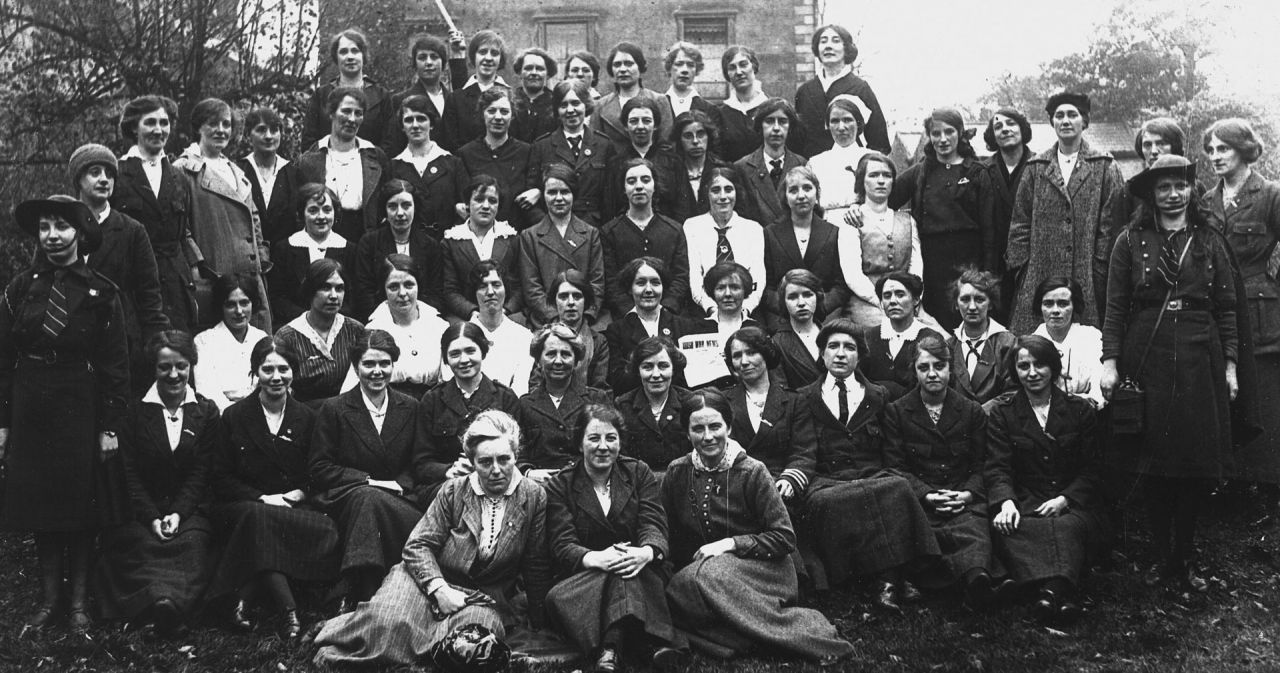
Cumann na mBan members, 1916 (Richmond Barracks)
As Treston is one of my Irish ancestral names, and not a particularly common one at that, it caught my eye when I saw a Treston on a list of women participants in the 1916 Easter Rising.  I investigated, and though this particular Treston turned out to be a distant relative by marriage and not by blood, what I found is still pretty interesting.

According to the records of Richmond Barracks, Catherine "Cathleen" Treston, née Ryan, was a member of Cumann na mBan's Central Branch, and had been a nurse in the GPO garrison during the Rising.  She was detained in both Richmond Barracks and Kilmainham Gaol in the aftermath, and presumed to have been released on the 8th of May, though the Kilmainham records from this period have been lost.  She is present in the group photo here, taken in the summer of 1916 in the garden of Ely O'Carroll.  The woman in all white in the next to last row, wearing what appears to be a white nurse's cap, has been identified as Mrs. Catherine (Cathleen) Treston.  Cathleen would have been about 26 years old in 1916, going by her age in the 1911 census.  Her name is included in the 1936 Roll of Honour of participants in the Rising.

The 1911 census tells us a little about her home life in the years leading up to the Rising.  She was married to a dentist, William Treston, and was already the mother of two infant daughters.  She and her family lived with her widowed mother, two sisters who taught at the National School, and an aunt in a house in Ballybough Road.  Her husband's family, from what I can tell, descend from the Blackrock branch of the Treston family, who originated at some point in Mayo and are distantly related to mine.  So while Cathleen herself was not a cousin of mine, her husband and daughters certainly were, albeit distantly.

Sources:
Richmond Barracks, A list of women who were detained at Richmond Barracks
National Museum of Ireland, Women of the Roll of Honour
Sinéad McCoole, No Ordinary Women: Irish Female Activists in the Revolutionary Years, 1900-1923

Friday, April 14, 2017

The Will of Catherine Bonynge of Ratoath

The Four Courts, 30 June 1922
Photo courtesy NLI Commons
30 June 1922:  Three days into the Battle of Dublin, the first conflict in what will become the Irish Civil War, fire breaks out at the Four Courts, home to the Public Records Office, leaving the building a burned-out shell and destroying most of its 800 years' worth of holdings.  To this day the precise point of origin of the conflagration remains unclear; the building had been under heavy shelling by the Free State army for the previous two days while anti-Treaty Irregulars were holed up inside. The one indisputable fact of the destruction of the Four Courts is that much of Ireland's official recorded history went with it, including nearly all of the wills held by the Principal Registry.  This background is necessary to explain why the survival of any of Catherine Bonynge's will, let alone as large a portion of it as we have, is somewhat remarkable.

Catherine Bonynge (or Bonnynge) was one of the two sisters memorialized at Glasnevin Cemetery by Dr. Laurence O'Reilly of Ratoath, Meath, buried in the same plot as Dr. O'Reilly and his brother and (possibly?) sister, James and Bridget O'Reilly.  She and her sister, Bridget Bonynge, were spinsters who lived at Ratoath, and evidently owned quite a bit of Dublin real estate.  Both died within days of one another at Ratoath in 1841, and were buried together in Glasnevin Cemetery, Dublin, beneath a monument bearing their names and Dr. O'Reilly's.  The Prerogative Court, which proved Irish wills until the Principal Registry was established in 1858, did leave a surviving index of the wills recorded there, and shows that both Bridget and Catherine left wills.  Those originals would have been among the records destroyed by the Four Courts Fire in 1922, but a hefty portion of Catherine Bonynge's will survives, published with other Irish charitable bequests, among the Parliamentary session papers of 22 January-28 August 1846.  Unfortunately, whatever relationship existed between the Bonynge and O'Reilly families remains unanswered by this portion, though it is not outside the realm of possibility that Dr. O'Reilly may even be the unnamed executor.  Whatever questions it leaves unanswered aside, one thing it does provide us with is a small historical window into Dublin in the first half of the 19th century.  I have reproduced the surviving text in full and annotated it below:

Saturday, March 25, 2017

The Mystery of the Misses Bonnynge

Last October, while I was in Dublin, I took a trip to Glasnevin Cemetery on the northside of the city to visit some family graves.  My great-great-great grandparents, Laurence and Bridget (Treston) O'Reilly, are buried there as are four of their children and two of their grandchildren.  While those plots are unmarked, as many in the cemetery are, I did find a marker on another plot that raised some questions.

In the area of the old chapel (since demolished), the section of graves are still called the Chapel Circle.  My great-great-great grandfather's predecessor at Mount Albion House in Dundrum, James O'Reilly, and his brother, Dr. Laurence O'Reilly, as well as a presumed sister of theirs, Bridget, are all buried in the Chapel Circle section.  Now, I still haven't determined the precise relationship between these O'Reillys to mine, but my working theory is that James and Dr. Laurence are most likely uncles of my Laurence.  The surprise here is that the grave was marked after all (a previous attempt my parents made on an earlier trip had not found the correct location, it turned out), and not only that, the O'Reillys weren't alone.  The marker on the grave reads:

Photo © the author, 2016
Erected in memory of the
MISSES BONNYNGE.
By DOCTOR O'REILLY - Ratoath.
In life respected
In death regretted.
May they rest in peace amen.
J. Farrell Ft 1841
I knew this was the right O'Reilly, because he was a doctor and did live in Ratoath, but the Bonnynge name was wholly unfamiliar to me.  So who were they?  How were they connected to the O'Reillys?  Once I'd arrived back in the States, I emailed the cemetery's office and received confirmation that the O'Reilly plot and the Bonnynge plot were, in fact, one and the same.  I've also since uncovered some more information that superficially answers one of my initial questions - who they were.  That's an entire post in itself, though, so it will have to wait.

Additional historical note: the bottom left of the inscription is the mason's signature.  The "Ft" is probably an abbreviation of the Latin "fecit" - literally "J. Farrell made it".  To this day, the company of Farrell & Son continues to make headstones and monuments just down the road from the cemetery.  The Irish Times published an article on the history of the company back in 2008.

Post-Travel: Dublin

St. Kevin's, Harrington Street, Dublin
As you might have noticed, I've been on hiatus for quite a while.  Longer than I realized, even!  I spent quite a bit of last year prepping for a trip to Ireland at the end of the year, in which I managed to achieve some of my genealogical goals there, missed out on others, and created a few brand new ones.  Since then I've had a bit of a travel hangover, and subsequently got more than a little distracted with current events in America, but the less said of that, the better.

Accomplished: visiting one of the neighborhoods my Dublin ancestors lived in, walking down their streets and even stepping inside their parish church, St. Kevin's (pictured).  This one was a big one for me!  I also got to visit Glasnevin Cemetery, where many of them are buried, and got to see their gravesites as well as the graves of many people who are important to Irish history.

Missed out: visiting the National Library, National Archives, and Registry of Deeds.  Unfortunately, none of the days I was in Dublin corresponded with times any of these repositories were open.  The only weekday we were there was Halloween, which is a big public holiday in Ireland and so they were all closed that day too.  Next trip over I'm definitely staying in Dublin during the week!

Stained glass window, St. Kevin's
Brand new research goals:  I'll leave those to their own posts!  That's honestly been part of the problem picking up again and blogging, I can't decide where to even start.  Let's just say I've uncovered some interesting new research angles to explore with my Irish relatives, including a recent discovery of additional ties to Dublin in another branch of the family.  Of course, my main goal is to go back!  Dublin is an incredible city, and despite it not being "home", thanks to spending much of the last few years researching it, it felt comfortable and familiar.  There's so much to see and do there as well.  It truly is a global treasure and I couldn't help but understand why so many people in my family made it their home.

Photographs of St. Kevin's © the author, 2016.

Sunday, March 13, 2016

A Cross and a Creole

This past March 5th was "It's My Park Day" here in Austin, and so I signed up to spend the morning documenting headstones at Oakwood Cemetery.  Oakwood is the oldest cemetery in town, and I'd visited it before to locate headstones of relatives buried there.  In fact, we started out documenting directly across from one of those plots - that of my 3x great-granduncle Dr. William Neal Watt, a North Carolina native who'd followed two siblings to Burton, Texas before moving on to make his home in Austin.

Caroline Deblanc Fortier
July 1 1843 - June 21 1895
While documenting one of the plots, a stone in the one adjacent to it caught my eye.  It was a granite monument about 5 feet high, in the shape of what's known as a "fleur-de-lis" cross.  I like to call them "French crosses", because I always associate them with French Catholic iconography.  The surname on it, Fortier, seemed to go along with that association.  The group working that plot had some trouble with the inscription due to the morning sunlight hitting the wrong side of the stone, so a few of us had walked over to see if we could help out.  Once the necessary info was obtained, it was just about time to finish up and leave for the day.

Only that wasn't quite it.  Not for me.  Something about that stone just wouldn't leave me alone.  I wanted to know more about the woman buried beneath it: who she was, where she came from.  Rainy, overcast weather also kept me from going back to try to obtain a clearer shot of the stone during the week (as it turned out, afternoon light helped me get a much more legible inscription, as you can see).  Fortunately the cemetery's burial registers are easily accessible online via the Austin History Center, so I was at least able to do some preliminary legwork via the internet.  Since I knew the year of death I was able to locate the correct entry despite a mistranscription of the surname as "Fortin".  This was where I was in for a revelation:  Mrs. Caroline Fortier, who died in Austin in 1895, was said in the burial register to be from Liberty County, Texas.  Aha, I thought.  And then, Hmm, maybe...

From a further search through the census records of Liberty County from 1850-1880, I was able to deduce that Mrs. Fortier was née Caroline Deblanc, a daughter of one of the original interrelated Creole families who had come from Natchitoches Parish to Liberty County in the 1840s!  Since my 3x great-grandmother Esilla Rachal and her parents were also some of these Liberty Creoles it's almost certain they even knew each other and may have even been relatives.  Caroline's mother was a Gillard, another of the main Liberty migration families, and I found baptisms matching a couple of Caroline's siblings in the books of Natchitoches records I keep at home, confirming their identities as Natchitoches Creoles.  I don't have a match yet for Caroline in those books, but I'll keep looking and check into a few additional published sources of Louisiana records to see if anything turns up.

Since the Liberty Creoles have been an ongoing genealogical and historical research project of mine for some time, the discovery of one buried so close to my home is nothing short of serendipitous.  And to think, it was all because of that particular style of cross grabbing my attention.  The stone spoke and I listened, and found a Creole kinswoman as a result.

Tuesday, March 1, 2016

A Tale of Two Hannahs

This particular genealogical rabbit hole I've gone down highlights the importance of exploring every avenue in the search for our ancestors.  You just never know what possibilities a collateral line may open up.

One of my ancestors I don't know much beyond is my great-great grandfather Patrick DeWan, who came from Ireland to the U.S.  Perhaps the most useful information I was able to find came from his Pennsylvania death certificate, filed 1 January 1923, giving his parents' names as Michael DeWan and Hannah Britton.  He was certainly here sometime before the end of the American Civil War, as he appears, aged 26, in a draft registry from July 1863 in Herrick, Pennsylvania.  There was just one problem: I couldn't find him on the census until 1880.  In fact, he didn't seem to be in Pennsylvania at all for the census years of 1860 and 1870.

A new possibility opened up when I came across the obituary of Mrs. Nora McGovern, an in-law of the DeWans.  Nora was married to James McGovern, whose sister Anna was Patrick's wife and my great-great grandmother.  Their marriage record in 1897 showed James as the son of Patrick and Bridget McGovern, which I already knew, and Nora (here as Hanora) was the daughter of Charles and Hannah McKanna.  I hadn't found a death record for Nora, and the obituary told me why.  I was looking in the wrong place - she died in Harrisburg, not Herrick.  Once I knew the place and date, pulling up her death certificate was fairly easy.  Nora's father, according to her death certificate, was named Charles McKenna.  Much to my surprise, I saw a familiar name - Nora's mother was also named Hannah Britton!  It seemed almost too coincidental, so I set about trying to find Nora's family in the records to see if I might be able to make a connection between her Hannah and Patrick's.  Could these two mothers with the same name have been the same person?  Could Nora have been Patrick's half-sister, in addition to a sister-in-law?  (Nora's sister, Ann, had their mother's name as Bridget Britton on her death certificate, but this is the only incidence I've found of her name recorded as something other than a variant of Hannah.)

In the 1870 census for Herrick, I found the family listed under McCanna: head of house Charles, then Hannah, and daughters Anna, Hannah (Nora), and Mary.  Interestingly, below the name of the youngest daughter was written another name: Patrick, aged 25!  Was it possible this was Patrick DeWan, and the census taker simply hadn't bothered to ask if he had a different last name than the rest of the house?  I decided to try to find them in 1860.  This time I found them all under McCamna: Charles, Hanora, Patrick (19), Michael (15), Ann (4), Hanora (3), and Mary (1).  Patrick's death certificate gave his father's name as Michael DeWan, and one of his sons had Michael as a middle name.  Could it be possible that once again the DeWans were listed as McKannas on the census?  It isn't unheard of for stepchildren to be recorded in the census under a stepfather's surname.  There's also quite a large gap in the ages of the children listed, which lends some credence to the possibility that not all these children were full siblings.  Patrick and Michael also are listed as being born in Ireland, and the girls were all born in Pennsylvania.  At this point I double checked for McKannas among the 1863 draft list that Patrick DeWan had appeared in.  I did find a Patrick McKanna - but he was 36 years old in 1863, making him less likely to be the same Patrick who was enumerated with Charles and Hannah's household.  A browse through the 1850 census of Herrick turns up a full household of McKanas - including a 30 year old Charles, who appears to be single, and a 22 year old Patrick who more closely matches the draft register's Patrick McKanna - and no DeWans or Brittons.

Out of curiosity, I went forward, looking for Charles and Hannah in 1880, and found something else unexpected: their household was located directly next to that of Patrick and Anna "Dwan", my great-great grandparents, who had been married within the year.  The lack of the 1890 census means a gap in the records that can't be accounted for, but the death register and cemetery listings for the area do tell us that Charles and Hannah died in the 1890s.

I think my next obvious step is to try to find a marriage record somewhere for Charles and Hannah.  If the 1850 census is for the correct Charles, it seems likely the marriage took place in or near Herrick between 1850 and 1855.  The Catholic records for the area may turn up something.  A search in the probate records may also be useful to see just who inherited Charles and Hannah's farm.