I went to school to be an archaeologist and realized digging in dirt wasn't as fun as it was when I was a kid. Now I dig in archives instead.

Sunday, March 13, 2016

A Cross and a Creole

This past March 5th was "It's My Park Day" here in Austin, and so I signed up to spend the morning documenting headstones at Oakwood Cemetery.  Oakwood is the oldest cemetery in town, and I'd visited it before to locate headstones of relatives buried there.  In fact, we started out documenting directly across from one of those plots - that of my 3x great-granduncle Dr. William Neal Watt, a North Carolina native who'd followed two siblings to Burton, Texas before moving on to make his home in Austin.

Caroline Deblanc Fortier
July 1 1843 - June 21 1895
While documenting one of the plots, a stone in the one adjacent to it caught my eye.  It was a granite monument about 5 feet high, in the shape of what's known as a "fleur-de-lis" cross.  I like to call them "French crosses", because I always associate them with French Catholic iconography.  The surname on it, Fortier, seemed to go along with that association.  The group working that plot had some trouble with the inscription due to the morning sunlight hitting the wrong side of the stone, so a few of us had walked over to see if we could help out.  Once the necessary info was obtained, it was just about time to finish up and leave for the day.

Only that wasn't quite it.  Not for me.  Something about that stone just wouldn't leave me alone.  I wanted to know more about the woman buried beneath it: who she was, where she came from.  Rainy, overcast weather also kept me from going back to try to obtain a clearer shot of the stone during the week (as it turned out, afternoon light helped me get a much more legible inscription, as you can see).  Fortunately the cemetery's burial registers are easily accessible online via the Austin History Center, so I was at least able to do some preliminary legwork via the internet.  Since I knew the year of death I was able to locate the correct entry despite a mistranscription of the surname as "Fortin".  This was where I was in for a revelation:  Mrs. Caroline Fortier, who died in Austin in 1895, was said in the burial register to be from Liberty County, Texas.  Aha, I thought.  And then, Hmm, maybe...

From a further search through the census records of Liberty County from 1850-1880, I was able to deduce that Mrs. Fortier was née Caroline Deblanc, a daughter of one of the original interrelated Creole families who had come from Natchitoches Parish to Liberty County in the 1840s!  Since my 3x great-grandmother Esilla Rachal and her parents were also some of these Liberty Creoles it's almost certain they even knew each other and may have even been relatives.  Caroline's mother was a Gillard, another of the main Liberty migration families, and I found baptisms matching a couple of Caroline's siblings in the books of Natchitoches records I keep at home, confirming their identities as Natchitoches Creoles.  I don't have a match yet for Caroline in those books, but I'll keep looking and check into a few additional published sources of Louisiana records to see if anything turns up.

Since the Liberty Creoles have been an ongoing genealogical and historical research project of mine for some time, the discovery of one buried so close to my home is nothing short of serendipitous.  And to think, it was all because of that particular style of cross grabbing my attention.  The stone spoke and I listened, and found a Creole kinswoman as a result.

Tuesday, March 1, 2016

A Tale of Two Hannahs

This particular genealogical rabbit hole I've gone down highlights the importance of exploring every avenue in the search for our ancestors.  You just never know what possibilities a collateral line may open up.

One of my ancestors I don't know much beyond is my great-great grandfather Patrick DeWan, who came from Ireland to the U.S.  Perhaps the most useful information I was able to find came from his Pennsylvania death certificate, filed 1 January 1923, giving his parents' names as Michael DeWan and Hannah Britton.  He was certainly here sometime before the end of the American Civil War, as he appears, aged 26, in a draft registry from July 1863 in Herrick, Pennsylvania.  There was just one problem: I couldn't find him on the census until 1880.  In fact, he didn't seem to be in Pennsylvania at all for the census years of 1860 and 1870.

A new possibility opened up when I came across the obituary of Mrs. Nora McGovern, an in-law of the DeWans.  Nora was married to James McGovern, whose sister Anna was Patrick's wife and my great-great grandmother.  Their marriage record in 1897 showed James as the son of Patrick and Bridget McGovern, which I already knew, and Nora (here as Hanora) was the daughter of Charles and Hannah McKanna.  I hadn't found a death record for Nora, and the obituary told me why.  I was looking in the wrong place - she died in Harrisburg, not Herrick.  Once I knew the place and date, pulling up her death certificate was fairly easy.  Nora's father, according to her death certificate, was named Charles McKenna.  Much to my surprise, I saw a familiar name - Nora's mother was also named Hannah Britton!  It seemed almost too coincidental, so I set about trying to find Nora's family in the records to see if I might be able to make a connection between her Hannah and Patrick's.  Could these two mothers with the same name have been the same person?  Could Nora have been Patrick's half-sister, in addition to a sister-in-law?  (Nora's sister, Ann, had their mother's name as Bridget Britton on her death certificate, but this is the only incidence I've found of her name recorded as something other than a variant of Hannah.)

In the 1870 census for Herrick, I found the family listed under McCanna: head of house Charles, then Hannah, and daughters Anna, Hannah (Nora), and Mary.  Interestingly, below the name of the youngest daughter was written another name: Patrick, aged 25!  Was it possible this was Patrick DeWan, and the census taker simply hadn't bothered to ask if he had a different last name than the rest of the house?  I decided to try to find them in 1860.  This time I found them all under McCamna: Charles, Hanora, Patrick (19), Michael (15), Ann (4), Hanora (3), and Mary (1).  Patrick's death certificate gave his father's name as Michael DeWan, and one of his sons had Michael as a middle name.  Could it be possible that once again the DeWans were listed as McKannas on the census?  It isn't unheard of for stepchildren to be recorded in the census under a stepfather's surname.  There's also quite a large gap in the ages of the children listed, which lends some credence to the possibility that not all these children were full siblings.  Patrick and Michael also are listed as being born in Ireland, and the girls were all born in Pennsylvania.  At this point I double checked for McKannas among the 1863 draft list that Patrick DeWan had appeared in.  I did find a Patrick McKanna - but he was 36 years old in 1863, making him less likely to be the same Patrick who was enumerated with Charles and Hannah's household.  A browse through the 1850 census of Herrick turns up a full household of McKanas - including a 30 year old Charles, who appears to be single, and a 22 year old Patrick who more closely matches the draft register's Patrick McKanna - and no DeWans or Brittons.

Out of curiosity, I went forward, looking for Charles and Hannah in 1880, and found something else unexpected: their household was located directly next to that of Patrick and Anna "Dwan", my great-great grandparents, who had been married within the year.  The lack of the 1890 census means a gap in the records that can't be accounted for, but the death register and cemetery listings for the area do tell us that Charles and Hannah died in the 1890s.

I think my next obvious step is to try to find a marriage record somewhere for Charles and Hannah.  If the 1850 census is for the correct Charles, it seems likely the marriage took place in or near Herrick between 1850 and 1855.  The Catholic records for the area may turn up something.  A search in the probate records may also be useful to see just who inherited Charles and Hannah's farm.

Saturday, October 10, 2015

The Scotts of Scot's Hall Portraits

The idea for this post came from the discovery that several Scott family portraits are now in the collection of the North Carolina Museum of Art.  These portraits were all among those reproduced as engravings in 1876 for the privately published "Memorials of the family of Scott, of Scot's Hall", so I thought I'd go through the portrait list published in the book and see how many I could track down to the present day.  This does not include any of the family memorials, which presumably have not left the church walls and floors they were placed on!  Where possible, I have provided a link to view the actual portrait, as the quality of the engraved reproductions varies substantially.  The provenance of the portraits at least until 1876 can be relatively assured: it was then that the engravings were reproduced with the permission of the widowed Mrs. Thomas Fairfax Best.  Mrs. Best's deceased husband was the son of Caroline Scott and Mr. George Best (per Burke's Landed Gentry) and a grandson of Edward and Margaret (Sutherland) Scott of Scot's Hall.  Portrait locations will be added as discovered.

Portrait of Reginald Scott, 1542 - NC Museum of Art
Portrait of Sir Thomas Scott, 1585 - unknown, though the engraving matches copies in the NPG from 1803
Portrait of Sir John Scott of Nettlested - NC Museum of Art
Portrait of Lady Elizabeth Scott - NC Museum of Art, identified as Emmeline Scott
Portrait of Lady Catherine Scott - NC Museum of Art
Portrait of the celebrated Mary Honywood - NC Museum of Art
Portrait of Edward Scott, Esq. D.C.L. - unknown
Portrait of George Goring, Earl of Norwich, Commander of Royalist Forces, Kent - unknown
Portrait of the Countess of Norwich -unknown
Portrait of Colonel George Goring (may be misidentified; see NPG collection) - NC Museum of Art
Portrait of Sir Thomas Scott - unknown
Portrait of Lady (Caroline) Scott - unknown
Portrait of George Scott, Esq. of Scot's Hall - unknown
Portrait of Anne Pemberton, 1st wife of George Scott, Esq. - unknown
Portrait of Cecilia Dering, 2nd wife of George Scott, Esq. - unknown
Portrait of Commodore Scott - unknown
Portrait of Margaret Sutherland, wife of Edward Scott, of Scot's Hall - unknown
Portrait of the Honble. Lady Mary Compton, wife of Captain Arthur Scott, R.N. - NC Museum of Art
Portrait of Caroline Scott, wife of Thomas Best, of Chilston Park, Kent - unknown
Portrait of Thomas Best, Esq., M.P., of Chilston Park - last sold in 1997, buyer unknown
Portrait (Medallion), Mrs. George Best, Chilston Park - auctioned; buyer unknown

So now let's talk about the attributions provided by the book.

Thursday, August 6, 2015

Oceanic: Queenstown to Ellis Island, May 1913

This one's a very special post for me, as it combines one of my favorite things, historic ships, with a truly amazing find in an immigration document that confirms quite clearly my previous research.

To the right is a photo of the White Star Line's Oceanic (II), which was built at Belfast's Harland & Wolff shipyard in 1899.  Until 1901 this ocean liner was the largest ship in the world, and until requisitioned by the Royal Navy in 1914 and run aground that same year off Shetland, she carried thousands of immigrants to new lives in America from the ports of Cherbourg, Southampton, Liverpool, and Queenstown (Cobh).

One such passenger, who boarded Oceanic at Queenstown on 8 May 1913 and debarked at Ellis Island one week later on the 15th, was Laurence O'Reilly of Ballyhaunis, Mayo.  Before I go into what the ship's manifest says about him, I'd like to fill in a little background on him first.  He was born on 2 December 1883 and baptized Laurence Christopher O'Reilly on 5 December 1883 at St. Agatha's, Dublin (Laurentius Christopherus O'Riely in the transcribed record).  His father, Laurence John O'Reilly, a Superintendent in the Dublin Metropolitan Police, was head of the household in the 1901 Irish census when the entire family lived at 5 North Richmond Street.  Laurence Christopher, the oldest son, was 17.  By 1911, Supt. O'Reilly had retired and moved his family back to his home county of Mayo.   27-year-old Laurence Christopher is still in their household at Carrowneden, just outside Ballyhaunis, in the census of that year.

The first page of the manifest of Oceanic's May 1913 voyage gives his age as 28 (he had actually turned 29 the previous December), says he is a shop assistant, of British nationality and Irish origin, last residence is Ireland and his father is Laurence O'Reilly of Ballyhaunis.  It's on the second page of the manifest that things get really interesting: the younger Laurence's destination is Hazleton, Pennsylvania (spelled "Hazelton" on the manifest), his steerage ticket was paid by his father back in Ireland, and the relative he was on his way to was his "Aunt Mrs. Delia Fagan" of Lattimer Mines.  And there it was: my great-great grandmother's name, in black-and-white, confirmed as the sister of this Laurence's father!  Even though I was already sure of her place within the O'Reilly family back in Ireland based on the few records I had, the surviving records contained some inconsistencies in names and dates.  This passenger list explicitly laid out the family relationship, and since it refers to her married name, Fagan, there's absolutely no doubt of her identity.  It was exactly the kind of concrete evidence I'd hoped to find, and in a most unexpected place!  This definitely ranks very high on the list in terms of the most exciting family document finds for me.

The lesson here is that it's always worthwhile to check immigration records for collateral relatives.  You may be surprised what information the passenger lists for these other relatives can tell you about people in your own direct line, and they may provide precisely the evidence you need to link your own family back to their family of origin in their native country.

For more on Adelia O'Reilly Fagan:
What's in a name? Adelia, Delia, Bedilia and Bridget; or check out all posts tagged "O'Reilly".

Image: 'Oceanic' moored at Harland & Wolff shipyard, Belfast courtesy PRONI (via flickr)
Sources:
Ancestry.com. New York, Passenger Lists, 1820-1957 [database on-line]. Provo, UT, USA: Ancestry.com Operations, Inc., 2010.
The National Archives of Ireland. Census of Ireland 1901/1911 and Census fragments and substitutes, 1821-51 [database online.]
Department of Arts, Heritage and the Gaeltacht.  Church Records [database online].

Thursday, July 30, 2015

Filling In Gaps with the NLI Parish Registers


The biggest, most exciting event for genealogists researching Irish roots this year has got to be the release of hundreds of digitized images from the National Library of Ireland's collection of church parish registers.  Thanks to these records, I've been able to fill in some gaps and address some of my speculation regarding my own research.

1) I had theorized that a baptism record for Julia Bridget O'Reilly in the parish of Bekan, Mayo, which I believed to be my great-great grandmother Adelia's baptism, had been misread and that what someone had read as Julia could be Delia.  As it turns out, the transcription was incorrect, just not in the way I had thought it would be.  She was actually baptized Julia Bedelia O'Reilly.  That name makes me even more sure that the record is my great-great grandmother's, for reasons which I've already explored in a previous post.

2) I had also suspected that an Isaac O'Reilly who lived in Rathfarnham was the same person as one of Adelia's nephews, a son of her brother James.  Finding the marriage record of Isaac and his wife Julia (Mannering) in the parish records of St. Joseph's in Terenure confirmed that Isaac was indeed the son of James O'Reilly and Margaret Rothery.  Furthermore his witness at the marriage was none other than Laurence O'Reilly of 5 North Richmond Street, his uncle and James and Adelia's brother.  The record also provided the important information that Isaac's parents were living in the U.S. in Delaware City, Delaware.  Thanks to that clue, I looked into Delaware records and was able to track down both the baptism record of Isaac's sister Sarah and the marriage record of his brother Laurence.

Search the NLI Parish Register collection

Postcard image of St. Joseph's Terenure courtesy South Dublin Libraries 

Thursday, July 16, 2015

Dr. Watt of Oktibbeha County, Mississippi

This is a brief follow-up to a previous post I wrote on members of the Watt family buried in Steele Creek ARP Cemetery in Charlotte, North Carolina.  Among the graves of the immediate family of the Rev. James Bell Watt was a gravestone for a Dr. William J. Watt who had died in 1857.  I didn't know the name, but wondered whether he could be the younger brother of Rev. Watt referred to in a biographical entry on one of Rev. Watt's sons.  I've since found some additional information on him and his possible relationship to the Steele Creek Watts.

In 1850, a "Doc" William J. Watt, whose age matches that of the gravestone at Steele Creek, is living in Oktibbeha County, Mississippi.  The name that follows his, Virginia, is evidently his wife, and the census indicates they have married within the year.  His birthplace is given as South Carolina, and if we'll recall, Rev. Watt was also originally from Fairfield County, South Carolina.  The 1860 census shows Virginia Watt as the head of household in Starkville, Oktibbeha County, as would indeed be the case if her husband had died in 1857!  Notice also that their oldest son is named James Bell Watt.  Their younger son John apparently died later that year.  His gravestone stating he is the son of "W. J. and V. C. Watt" is located in the ARP Cemetery in Starkville.  That same cemetery is full of Watts, Bells, and Montgomerys who came from the Fairfield District and were all kin to the Steele Creek Watts, including three of the brothers of Rev. Watt's first wife, Nancy Bell.  By 1870 Virginia Watt had married again, when her two surviving Watt children can be found in the household of her second husband, James P. Curry.  In 1880 she is a widow again, and lives with her Curry children.  Her son James B. Watt is enumerated just above her.  Her daughter Margaret Watt married Dr. Samuel A. Montgomery, a descendant of the Fairfield Montgomerys; further information on him can be found on page 450 of this book.  Virginia herself lived until 1899, and is buried in Odd Fellows Cemetery in Starkville, Mississippi.

Given the heavy presence of Fairfield County natives in the Starkville ARP congregation, particularly of those closely connected to the family of Rev. James Bell Watt, my opinion is that it is likely that "Doc" Watt who appears on the census in 1850 was also from Fairfield County.  I think it is also likely that he is the same person buried at Steele Creek and that he was the brother that Rev. Watt's son's biography referred to.  Of course, my investigation is still not complete and there are still offline sources I'll need to hunt down and check up on, but so far nothing found rules this particular relationship out.  Quite the contrary, what circumstantial facts we have would seem to support it.

Sunday, July 12, 2015

A Tragedy at Campti

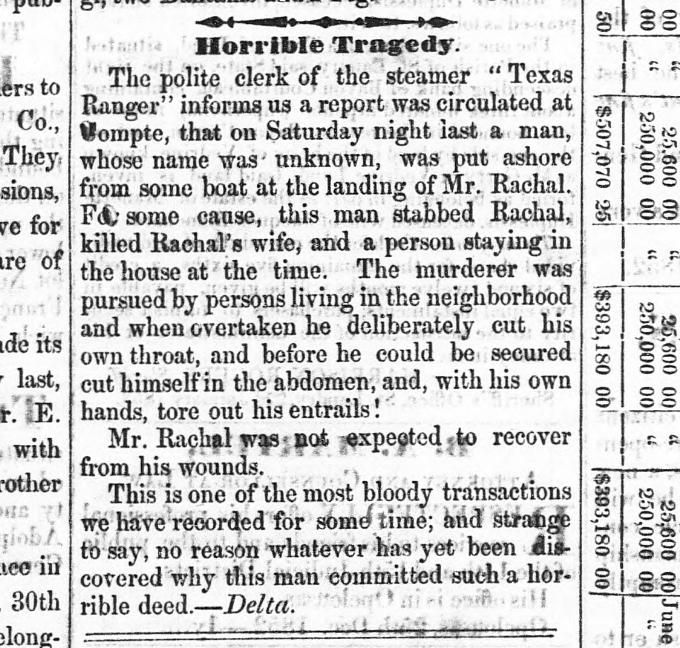
The Opelousas Courier, 12 Feb 1853
Again I'm bringing clippings from the Opelousas Courier relating to people from the Natchitoches area.  These two, which I came across while working on the post relating to deaths at Cloutierville published in the same journal, recount the story of a bizarre and inexplicable crime befalling a member of the Rachal family.  It's precisely the type of story that often gets lost or only hazily passed down among the simple aggregation of names and dates that often constitutes a genealogy.  The brief account in English is included here in the image to the right; below is my translation of the further details published the following week in the French edition of the same paper:

On the evening of 21 January [1853], a man named Samuel Summers disembarked from the steamboat John Strader at Rigolet de Bon Dieu and spent the night at the home of Mr. Cockfield.  The following day and night he proposed to spend at the home of Mr. Onézime Rachal.  In the afternoon he chatted with a person named Standish, and engaged him to go outside with him.  Standish agreed to his wishes and accompanied him outside; but they were just a few paces from the house when Summers drew from his pocket a knife and tried to cut his throat.  Standish, in resisting, received such a deep wound to his abdomen that his entrails were exposed.  A few moments after he ceased to live.

Drawn by the noise of the fight, Mr. and Mme. Rachal appeared outside; Summers, when he saw them, rushed toward them, knife raised, and inflicted several blows to the husband and wife.  The latter was mortally wounded.  The house-guests and servants, at the sight of the appalling tragedy, were seized with panic and fled.

As the news of what had happened spread throughout the neighborhood, many inhabitants armed themselves in haste and went in pursuit of Summers.  They found him after half an hour in a field belonging to Mme. Metoyer, two miles from the Rachal residence, but he had attempted suicide, for he had a large wound to the throat and three others to the abdomen.  He was taken to the prison and succumbed there during the night.  It is thought that Summers was a madman escaped from some hospital.  It is indeed impossible to conceive of such a crime on the part of a man capable of reason.

I searched the Natchitoches books I have copies of to try to determine who Onezime Rachal's parents were, without any luck.  I don't own a copy of every published Natchitoches record book that exists, though, so it is possible I may yet find him the next time I consult one of those in a library.  The 1850 census contains an entry for an "Onizieme Rachal" with a wife named Amelia.  The 1832 baptism of Marie Aimée Liegue Brevel, daughter of Jean Bte. Brevel and Marie Euphrosine Lestage, was sponsored by Onézime Rachal and Marie Aimée Lestage, "Mrs. Onézime".  Baptisms in the 1840s that Onézime sponsored are sometimes co-sponsored by either Emelie Lestage or Emelie Rachal.  Are Emelie and Aimée the same person, or is Emelie a second wife?  Is Amelia a census enumerator's anglicization of her name?  And is Emelie Lestage the Mme. Onézime Rachal who was killed at Campti?

Sources:
The Opelousas Courier, 12 February 1853 <http://chroniclingamerica.loc.gov/lccn/sn83026389/1853-02-12/ed-2/seq-2/>
Le Courrier des Opelousas, 19 February 1853 <http://chroniclingamerica.loc.gov/lccn/sn83026389/1853-02-19/ed-1/seq-1/>
Ancestry.com. 1850 United States Federal Census [database on-line]. Provo, UT, USA: Ancestry.com Operations, Inc., 2009.
Riffel, Judy. Natchitoches Baptisms, 1817-1840: Abstracts from Register 6 of St. Francis Catholic Church, Natchitoches, Louisiana. Baton Rouge: Comite Des Archives De La Louisiane, 2007.
Riffel, Judy. Natchitoches Baptisms, 1841-1849: Abstracts from Register 9 of St. Francis Catholic Church, Natchitoches, Louisiana. Baton Rouge: Comité Des Archives De La Louisiane, 2010.